🤖 Sending a Mecha to Pick Up a Pen
A mecha powers up, burns metric tons of fuel, and marches across the block to pick up the pen you dropped. Every AI coding pitch is that mecha. Why "more advanced" quietly replaced "actually better" — and why the person selling the win built it himself.
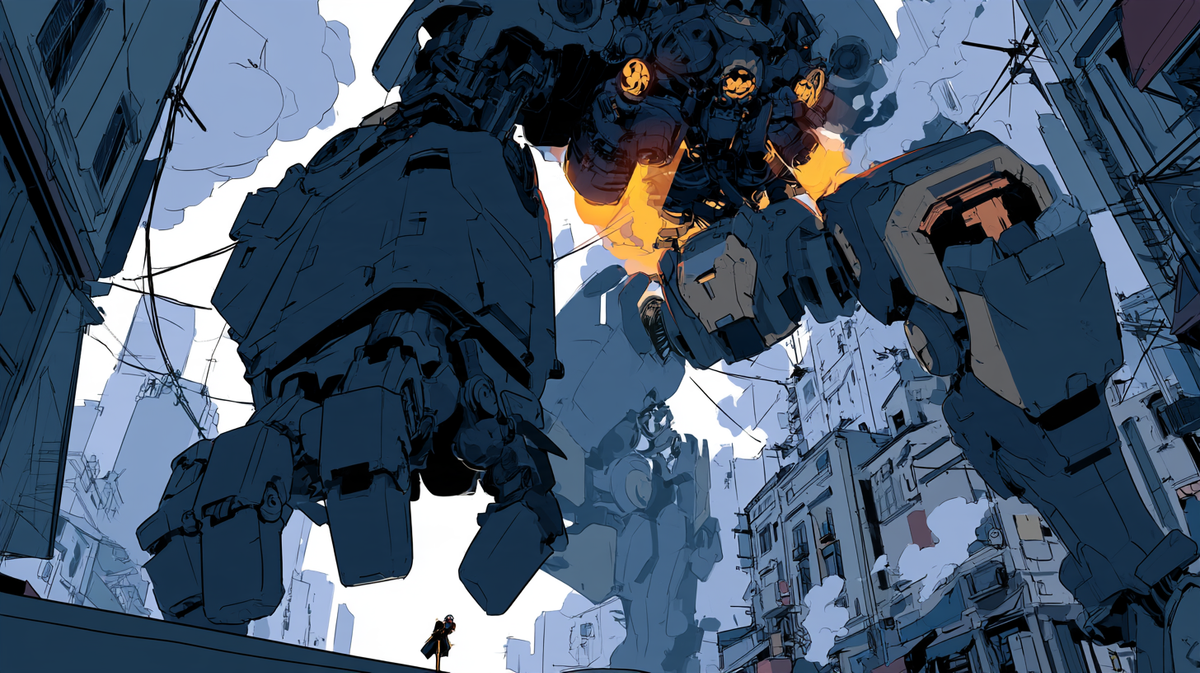
The mecha wakes up.
Pistons fire. Rotators spin up with a whine that rattles windows three blocks over. Cooling vents hiss white. Two stories up, the cockpit eyes flicker amber, then hold steady green. Somewhere inside that armored skull, a technician runs six pre-flight checks, straps into a harness built for combat, and calls the ignition.
Ten thousand tons of alloy take their first step. The ground doesn't shake so much as comply. Turbine hybrids the size of a shipping container burn fuel at a rate that would embarrass a naval destroyer. Servos flex, adjust, flex again, each one engineered to survive an artillery strike. The whole apparatus advances, block by thunderous block, toward its objective.
The pen you dropped.
It picks it up. Two fingers, delicately, the way you'd expect from something built to punch through a tank. Mission accomplished. Power down. Return to hangar.
The pen is mightier than the sword — nobody who wrote that expected the pen would need an exoskeleton to retrieve it off the floor.
Every AI coding pitch, boiled down, is that mecha. The actuators work. The grip calibrates. The pen gets picked up. Nobody in the demo mentions that your hand already does this in a quarter second, for free, with zero boot sequence. The mecha isn't incompetent. It's just answering a question nobody asked.
This post is about why we keep building the mecha anyway — and why the answer has less to do with AI than with what we've quietly agreed counts as progress.
🤖 The Thread That Started This
Saw a Slack thread this week that was a perfect specimen. One engineer, unprompted: "serious question — why are you still using an IDE? Claude CLI has entirely replaced IDEs for me."
The other engineer's answer was almost apologetic: I'm not, really. But sometimes I like having one — viewing diffs, mostly. It's partially nostalgia, I think.
Read that again. "Nostalgia." For an LSP. For jump-to-definition. For a side-by-side diff view that lets your eyes do in half a second what a terminal pager makes you scroll for. That's not nostalgia — that's muscle memory for thinking, and he talked himself into apologizing for it because the other guy's framing had already won the room before anyone noticed there was an argument to have.
Here's the detail that makes it sharper: the engineer making the "entirely replaced" claim happens to be one of the people who built the internal AI dev platform pushing that exact narrative company-wide. He's not a neutral observer reporting a workflow win. He's grading his own homework in public, on a claim he has every incentive to want true.
Nobody in that thread disagreed on capability. The agent can write the one-line fix. The question that never got asked: should it?
🔧 When the Mecha Actually Earns Its Keep
Here's the part that gets lost when these conversations turn into a referendum on how advanced your workflow sounds:
Agentic tools aren't bad. They're misapplied, constantly, by people optimizing for "look how automated my process is" instead of "did this actually make the work better."
Where the overhead pays off:
- 🔁 Mechanical thoroughness across scale — rename this, update the 40 call sites, don't miss one
- 🧭 Search across territory you don't know — you understand what needs to change, not where
- 🧱 Boilerplate-shaped work where explaining intent is cheaper than typing it
Where it's just a mecha and a pen:
- You already hold the exact diff in your head
- The blast radius is one line, known, verified in the reading
- The "explain → generate → review the agent's homework" loop costs more than just doing it
Translated to engineering: the agent doesn't have a floor cost of zero. Explaining intent, waiting on generation, verifying output — that's overhead with a fixed minimum, and it doesn't shrink to match a task that was already sub-second for you by hand. The tool didn't get faster. The task was already fast. Those aren't the same story, and conflating them is exactly how "entirely replaced IDEs for me" gets said out loud in a work Slack with a straight face.
📉 Why the Proxy Always Wins the Room
And here's why the mecha keeps getting built even when everyone half-knows it's overkill: nobody gets credit in a status update for the hand.
If I tell my manager "this cut my cognitive load," that's a claim only I can verify. Private. Unfalsifiable. Worth exactly nothing in a status update.
If I tell my manager "this cut PR turnaround by 40%," that's a number. Public. Comparable across teams. Something you can put on a slide and defend in a budget meeting.
Quality of life is real but private. Speed is fake — a proxy standing in for the thing we actually wanted — but it's public. And a public fake beats a private truth in every negotiation, every time, even among people who'd agree in the abstract that the fake isn't the point. That's not a moral failing. That's just what happens when a room full of strangers needs to agree on something in under thirty seconds.
The goal of technology was never to be faster, richer, more automated, or more advanced-sounding in a Slack thread. It was a better quality of life for the people using it. Somewhere along the way "faster" became the only claim anyone could actually prove, so it quietly became the goal instead of the evidence for the goal.
AI didn't invent this. Interstates optimized for commute time and delivered worse commutes and hollowed-out cities. Industrial agriculture optimized for yield-per-acre and delivered soil that can't hold a season. Social platforms optimized for engagement and delivered everything except connection. Every one of those technologies worked exactly as measured. They just measured the wrong thing, precisely enough that the wrong thing crowded out the right one.
Agentic coding tools are just the newest name on that list.
🪞 The Part I Keep Sitting With
I've spent a fair chunk of the last year writing about agentic tooling eating the parts of engineering that were never actually the bottleneck — the typing, not the vague ticket, not the missing test coverage, not the documentation nobody wrote. This thread is the same critique from a different angle: it's not just that we're automating the wrong layer of the stack. We're arguing about it using the wrong currency. "Replaced" is a capability claim. "Better" is a quality-of-life claim. Only one of them fits in a Slack message that gets a 👍 in under a minute, and it's not the true one.
I don't think the fix is a better agent. I think the fix is smaller and harder: protecting "this feels better to use" as a legitimate stopping point in a conversation, instead of every tooling debate quietly being a contest over who sounds the most advanced.
Quality of Life, Not Quality of Demo
The mecha still works. Nobody's arguing it can't pick up the pen.
The question was always whether picking up the pen needed ten thousand tons of steel and a technician's harness in the first place — and somewhere in the last few years, we stopped being allowed to ask it.
The pen was always mightier than the sword. It never needed a mech to lift it.
Be honest. You'd shake your head at me using my mecha to pick up a pen.