Annual Audits Are Absolute Agony
353K people liked a LinkedIn post about not wanting a performance review. That’s not viral content. That’s a suppressed scream. Here’s why the annual review is broken, gameable, and what it should actually be.
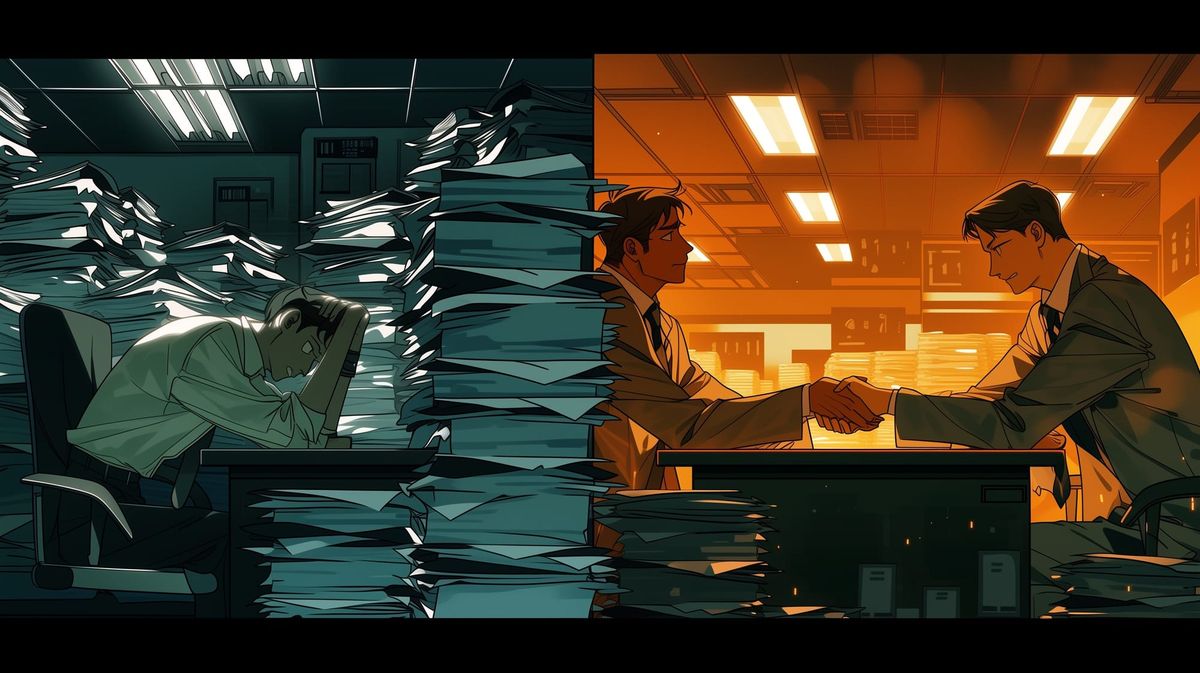
"You saw the work. You paid me. That was the agreement."
— Frustrated Employee, LinkedIn, 353K likes and a vibe check for the whole industry
353,000 people hit like on that post. That's not a complaint going viral. That's a collectively suppressed scream finally finding a button to press.
I've been on both sides of the annual review table. As an IC, I spent hours reconstructing a year of context into a document no one would read past February. As a manager, I read those documents and then wrote my own document summarizing the document. We were two people doing paperwork about the work instead of just... talking about the work.
This post is about why annual performance reviews are structurally broken, how they're gameable to the point of absurdity, and what I think they should actually be.
🎭 The Ritual Premise
The annual review assumes something that has never been true in any organization I've worked in: that a manager has been paying consistent, unbiased, longitudinal attention to your performance for twelve consecutive months.
They haven't. Nobody has. Stop pretending.
What actually happens: Q1 and Q2 blur into the past. Q3 maybe has one thing that sticks. Q4 is what they actually remember. The review reflects roughly one quarter of real observation dressed up in language that implies a full year — and we all just nod along like that's normal.
Then there's the visibility bias — the quiet truth that your work gets weighted by how often your manager saw it, heard about it, or could easily attribute it to you. The person who shipped the harder thing at 2am with no announcement got less credit than the person who demo'd in the all-hands. You know this. You've lived this. You've probably been the all-hands guy once or twice, let's be honest.
And the alignment tax — the unspoken reality that disagreeing with your manager, even when you were right, costs you review points. Not overtly. Just in how "collaborative" and "communicative" get scored when what they actually mean is "agreed with me."
The whole thing is a subjective retrospective wearing the costume of a fair process. And everyone in the room knows it's a costume. We just keep pretending it fits.
🎮 The Review Is Gameable (I'm Half-Kidding)
Here's the most damning thing about annual reviews: they're coachable in a way that has nothing to do with actual performance.
The playbook writes itself.
End of Q1, make a small, visible mistake. Not a catastrophic one. Something recoverable. A missed deadline on a non-critical feature. A PR that needed two extra rounds of review. Something your manager can see and name.
Then spend Q2 through Q4 narrating your own improvement arc. If your manager doesn't bring it up, you do. "I've been thinking a lot about how I handled the X situation and here's what I've changed." Hit every beat: awareness, accountability, behavioral shift, measurable result.
A good story is more memorable than raw fact. Always has been. The brain isn't storing your commit history — it's storing narrative. Your manager isn't grading your work. They're grading your screenplay.
You just manufactured a "shows growth" review out of a deliberate stumble and some strategic storytelling. Congratulations, you've out-performed actual performance.
The worst part? This works better than just being consistently excellent. Consistent excellence is invisible. It doesn't have an arc. It doesn't give your manager anything to narrate upward to their manager, which — surprise — is who this whole exercise was actually for the whole time.
The review system doesn't reward performance. It rewards legibility. And legibility is just performance art with extra paperwork.
📋 The HIPPO in the Room
Your objectives — the ones you both agreed to in January, the ones that are supposed to make the review "fair and objective" — were not actually about you.
They were about what the business needed in Q4 planning. Or what your manager committed to their skip-level. Or what the HIPPO (Highest Paid Person's Opinion) decided the org was optimizing for this year. You just got handed a goal sheet with your name typed at the top so it'd feel personal.
You dressed them up as your goals. You added one personal development item to make it feel bilateral. Cute. But the core of them was handed down, and you know it.
Then the business pivoted in March. The roadmap shifted in June. Half those objectives are now irrelevant and the other half got scope-changed three times by people who never bothered to tell you. And yet — come December — you'll be evaluated against them anyway. Maybe with some acknowledged context, maybe not, depending on how charitable your manager is feeling that quarter.
You're being graded on a test that changed after you took it, and somehow you're the one who's supposed to feel bad about the score.
🤝 What It Should Actually Be
Here's the take that will make some managers uncomfortable: the annual review should be a contract renegotiation, not a report card.
The employment relationship is a contract. You show up, do the work, produce outcomes. They give you compensation, growth, and a context worth working in. That's the agreement. "Frustrated Employee" had it exactly right, and it took 353K people liking a screenshot to say what HR departments have been dodging for decades.
An annual touchpoint should just be asking: are both parties still getting what they need?
From the employee's side:
- 💰 Is the compensation still reflecting the market — not the market from two years ago?
- 🧱 Has the scope of the role quietly expanded without anyone saying so out loud?
- 📈 Are the growth opportunities real, or are they the same "stretch project" you got promised last year that never materialized?
- 🎯 Do you actually understand what you're being measured against, or is it vibes with a rating attached?
From the employer's side:
- ✅ Is the work getting done, and at the quality bar that was actually agreed to?
- 🗣️ Are expectations clear, or has "clear" just meant "assumed and never said out loud"?
- 🤝 Is there mutual trust, or is one side quietly building a case file?
That's it. That's the whole review. A conversation between adults who are both accountable to the relationship — not a unilateral grading exercise dressed up as a dialogue.
What it isn't: one person filling out a form so another person can translate it into a number that was, let's be real, already decided in a calibration meeting you weren't invited to.
The feedback loop should be continuous. Mess up in March? I want to know in March, not in a Google Doc in December with a passive-aggressive "growth area" bullet attached. Doing well in July? I want to know in July — and ideally that means something beyond "good job," like, I don't know, money. The annual review shouldn't be delivering any news. It should be confirming what's already mutually understood and asking whether the terms still work.
If the December conversation is the first time you're hearing about a problem, that's not a performance failure. That's a management failure, and somebody should say so.
🔁 The Manager-as-Teammate Model
The LinkedIn post that started this whole thread has 353K likes because it's describing a relationship most people have never actually had with a manager: someone who's paying attention continuously, not auditing you annually like the IRS with a Slack account.
That's the teammate model, and it's not complicated. You don't do a quarterly retrospective on a teammate. You just work with them.
What that actually looks like:
- 🚩 Something's off? Say it that week. Not in Q4. This week.
- 🏆 Someone's crushing it? Say that too — out loud, not buried in a peer feedback form three people will skim.
- 🔄 Priorities shifted? Tell the team in real time, not retroactively when someone's objectives no longer make sense.
- 🙅 No surprises at year-end. If there's a surprise, that's evidence the loop was broken all year, not evidence the employee failed.
The best managers I've had operated this way. No performance surprises. No year-end essays. Just a living, ongoing understanding of where things stood — which, shockingly, is not a revolutionary management technique. It's just talking to people like they're people.
The worst ones? Excellent review writers. Detailed, structured, full of specific examples.
Examples they'd been saving up all year like ammunition.
Final Thought 💭
The annual review feels rigorous because it has a process. It has a form, a rating scale, a calendar invite, a calibration meeting. Process can masquerade as rigor for a long time before anyone checks whether it's producing anything real — and most companies never check, because checking would mean admitting the whole ritual is theater.
The goal was never the review. The goal was the relationship, the feedback, and the fair exchange of value. The review was supposed to be the artifact of all that. Somewhere, we flipped it. We started doing the review instead of the thing the review was supposed to reflect.
Stop writing reports about the work.
Do the work. Talk about it. Renegotiate when things change.
That was always the agreement. Everything else is just admin pretending to be insight.


