The Endgame of AI
Replacing the very people who power a consumer economy isn't smart. AI doesn’t buy used cars, finance loans, or pay rent. Technology should expand human capability, not quietly eliminate the economic engine that businesses depend on.
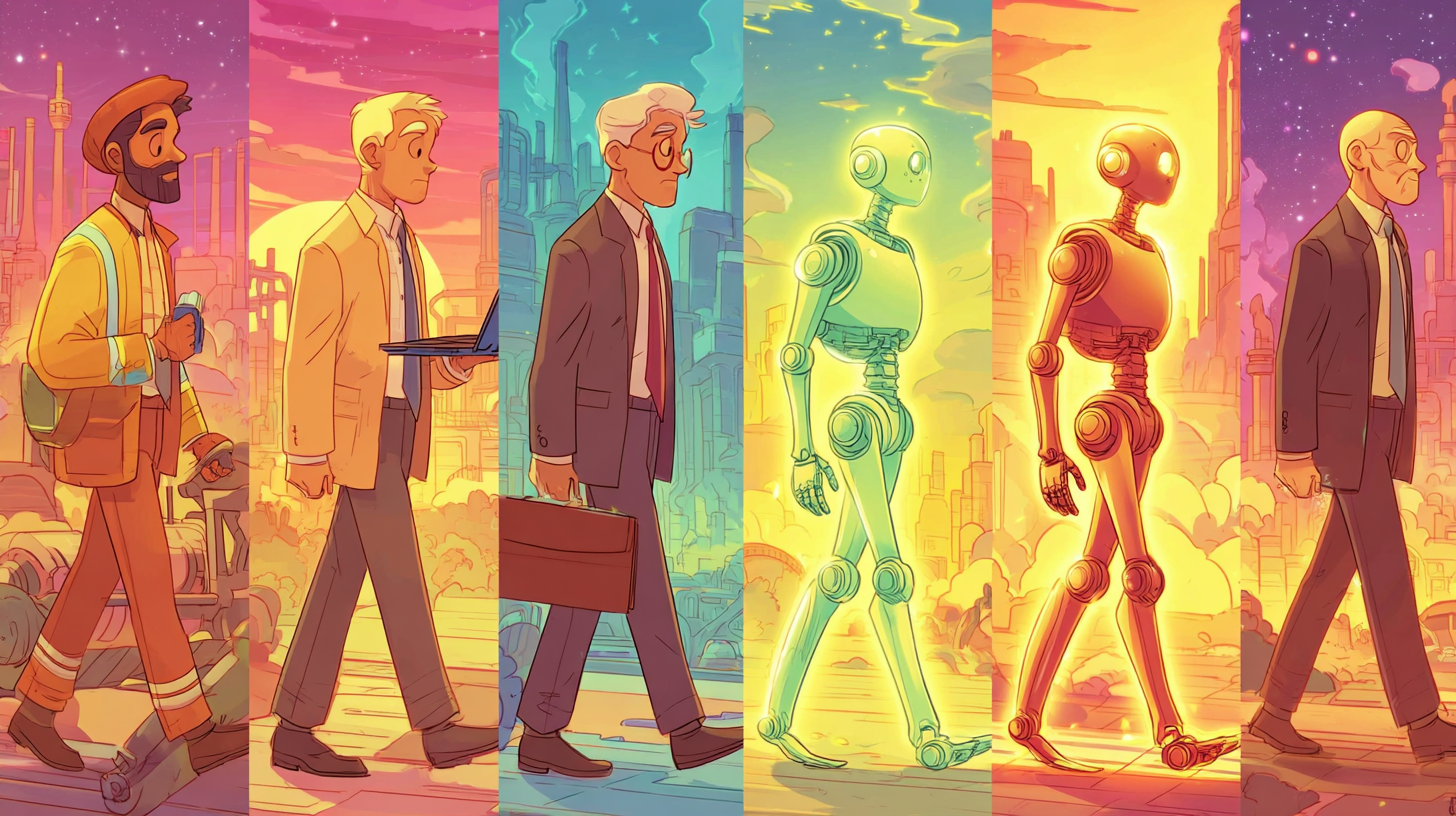
There’s a strange sci-fi movie playing out in boardrooms right now. 🎬
The plot goes something like this:
“If we replace enough workers with AI, profits will explode.”
Cue dramatic music. Charts go up. Executives nod sagely. 📈
But there’s a small detail missing from the screenplay.
The economy is a loop, not a vending machine. ♻️
The Economy Is a Circle, Not a Funnel
Every company likes to imagine itself at the end of the money stream.
Customers → buy product → company profits.
Simple.
Except the people buying the product are the same people whose labor powers the economy in the first place.
Take something like used cars. 🚗
A platform like CarGurus ultimately exists to help someone sell a car to someone else. The buyers are often ordinary people:
Teachers.
Plumbers.
Nurses.
Warehouse workers.
Office staff.
Engineers.
The working population.
Now run the “replace everyone with AI” fantasy to its logical conclusion.
- Warehouse workers replaced by robots 🤖
- Customer service replaced by LLMs 💬
- Analysts replaced by AI agents 📊
- Engineers replaced by code-gen models 💻
- Designers replaced by image models 🎨
Great. Efficiency achieved. 🎉
But then a strange economic question appears:
Who is left to buy the cars?
AI doesn’t need transportation.
AI doesn’t buy insurance.
AI doesn’t finance a used Corolla at 8.9%.
A consumer economy depends on consumers.
And consumers depend on income.
The moment companies collectively remove the income side of the equation, they quietly sabotage their own demand.
That’s not dystopian philosophy.
That’s basic economics.
Henry Ford understood this a century ago when he raised factory wages so workers could afford the cars they were building.
Somehow we’ve forgotten the lesson. 🏭
The Cannibalistic Business Model
If every company optimizes for replacing labor, something weird happens.
Each individual company may benefit in the short term.
But the system as a whole collapses its own demand base.
It’s a kind of corporate cannibalism. 🦴
Every company thinks:
“We’ll reduce labor costs and someone else’s customers will still buy our products.”
But if everyone does it, the market shrinks underneath them.
You can’t automate your way to a thriving consumer economy if you remove the consumers.
The Moral Question Nobody Wants to Ask
Even if the economics somehow worked out, there’s still a deeper question.
What is AI actually for?
Technology historically exists to improve human life.
- Electricity reduced dangerous labor ⚡
- Agriculture increased food supply 🌾
- Medicine extended lifespan 🧬
- Computers amplified human capability 💻
In every case, the goal was human flourishing.
If AI ends up being used primarily to eliminate livelihoods without replacing them with something meaningful, then the question becomes unavoidable:
What exactly are we optimizing for?
Efficiency without purpose is just a more sophisticated form of destruction.
The Difference Between Tools and Replacements
AI becomes powerful when it acts like a tool that amplifies people, not a machine that removes them.
A developer with AI becomes faster.
A doctor with AI diagnoses earlier.
A designer with AI explores more ideas.
A small business owner with AI can compete with larger companies.
In that world, productivity rises without removing the human engine of the economy.
The difference is subtle but massive.
One model says:
Replace people.
The other says:
Upgrade people. 🚀
One leads to contraction.
The other leads to expansion.
The Tech Industry’s Apple Problem
The tech world sometimes forgets that not every technology is an iPhone. 📱
Consumer gadgets follow a simple model:
Build → sell → upgrade → repeat.
But technologies like AI, automation, and large-scale platforms reshape the structure of society itself.
They influence:
- employment
- education
- economic mobility
- power distribution
Treating technologies with that level of impact like they’re just another product cycle is dangerously shallow thinking.
Some tools change the world.
And when you build those tools, you inherit responsibility for the world they shape.
The Real Endgame of AI
The future of AI shouldn’t be measured by how many people it replaces.
It should be measured by how much more capable people become because of it.
The real endgame isn’t a world where machines do everything.
It’s a world where humans can do things that were previously impossible.
More discovery. 🔬
More creativity. 🎨
More time spent on things that matter.
If the outcome of AI is simply a smaller number of people controlling increasingly automated systems while everyone else struggles to participate in the economy, that’s not progress.
That’s just a very advanced version of missing the point.
The strange irony is that the companies rushing hardest toward full automation may discover something unexpected.
The moment you remove people from the economy…
you remove the very reason businesses exist.