When You’re Choking on Meetings, Stop Eating Donuts 🍩💼
When meetings stop yielding results, the instinct shouldn’t be to add more — it should be to ask *why*. More meetings don’t solve the problem; they just make it harder to breathe.
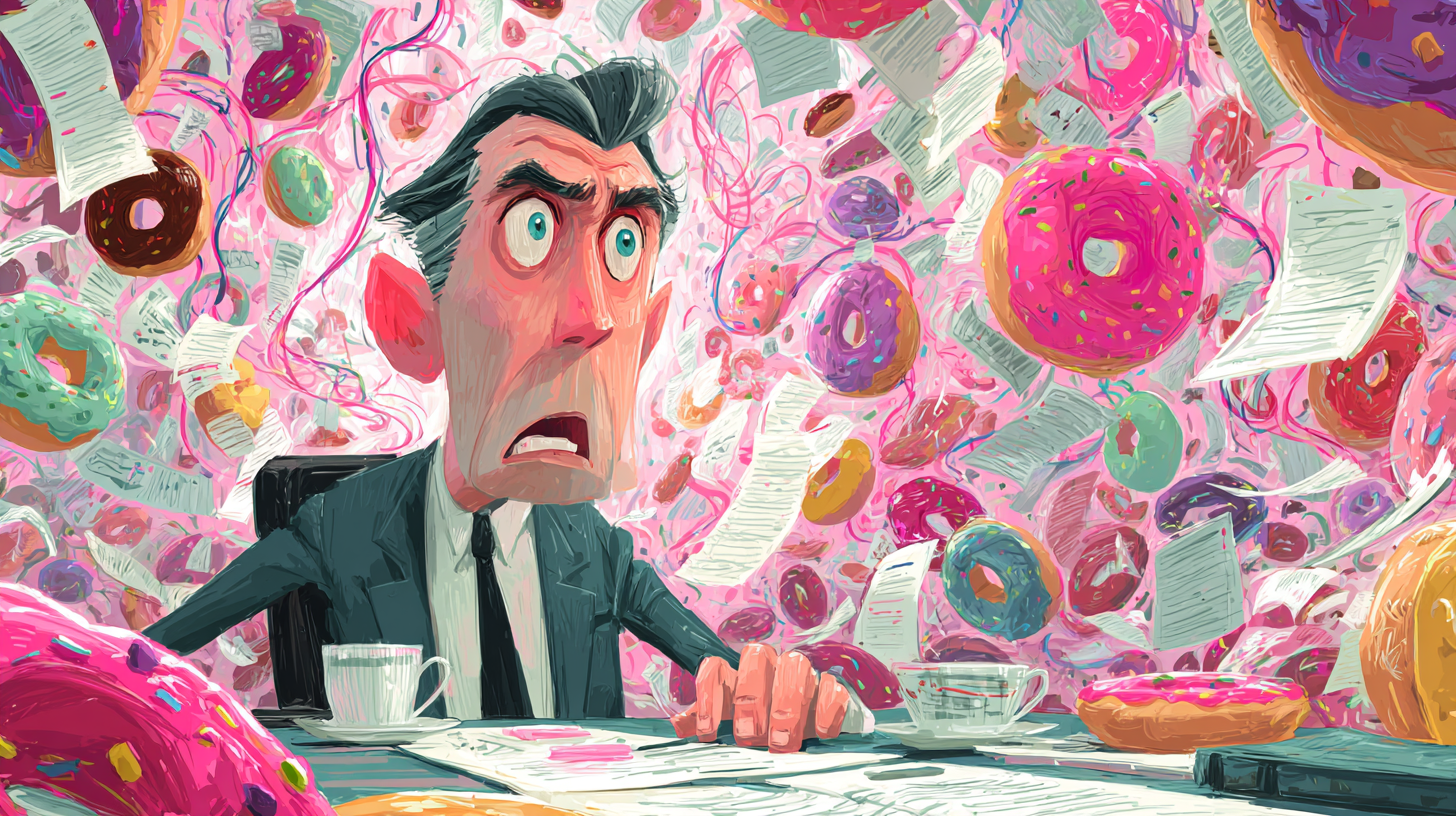
“Sometimes when I’m choking, I find that more food helps.”
— Jiminy Glick, played by Martin Short
There’s a Jiminy Glick skit where Martin Short’s character starts choking on a donut.
Instead of stopping, he panics — and shoves more donuts down his throat.
When he’s done, he delivers that line above with full sincerity.
I think about that every time I watch leadership teams respond to unproductive meetings with… more meetings. When coordination, collaboration, and clarity are missing, the reflex seems to be to increase quantity or duration instead of rethinking quality or purpose.
Why Leaders Reach for Meetings 🤔
Why is management so quick to reach for meetings?
Because it’s what they know.
It’s what’s safe.
It’s what they do.
Meetings feel like action. They give the illusion of progress — calendars full, conversations happening, boxes checked. But when meetings stop producing results, doubling down only feeds the dysfunction.
What leaders should reach for instead is creativity, courage, and passion:
- 🎨 Creativity to imagine new ways to collaborate.
- 🦁 Courage to give them a shot, even if it feels uncomfortable or unconventional.
- ❤️ Passion to care enough to do both — not just for optics, but for impact.
When to Reach for Meetings 🕒
Meetings are tools, not defaults. They’re best used when:
- ✅ A decision requires multiple perspectives and the context is complex.
- ⚡ Real-time discussion saves time compared to long async back-and-forths.
- 💬 There’s disagreement or ambiguity that needs emotional nuance or trust to resolve.
- 🎯 The goal is alignment, not just information sharing.
If none of those apply, you might not need a meeting.
Instead, reach for:
- 💻 Async updates (Slack threads, team channels, recorded Looms) for status checks.
- 📊 Shared documents or dashboards for visibility and context.
- 🎥 Short video clips or screen recordings for walkthroughs or demos.
- 🗒️ Decision logs or comment threads for feedback and traceability.
How to Evaluate a Meeting 💵
Before scheduling, ask yourself:
- What’s the expected outcome? (Decision, update, brainstorm, alignment?)
- Who needs to be there to achieve it? (Keep it small.)
- What’s the cost? Calculate the hourly rate of everyone invited, multiply by duration, and share the number.
- Example: 10 people × $100/hour × 1 hour = $1,000 meeting.
- Then ask, “Will this meeting deliver $1,000 worth of value?”
- Can this be achieved faster or clearer through another channel?
Sometimes just seeing the cost reframes the need entirely.
Smaller, Better, More Effective ⚙️
Large meetings are like large pull requests — hard to read, hard to review, hard to know if they’re safe, and more likely to cause friction.
We’ve learned that smaller PRs lead to higher quality, faster delivery, and better collaboration.
At our company, we’ve seen how monoliths become painful to maintain, while microservices create agility and independence.
The same lesson applies to meetings.
Instead of monolithic blocks of recurring time that bloat and slow everything down, break them apart. Make them smaller, more focused, and self-contained.
A Better Reflex 🌬️
When meetings fail to create alignment, don’t assume you need more.
Try fewer, shorter, sharper ones — or none at all.
Experiment with async updates, shared notes, or visual summaries.
Ask the people the meetings are supposed to help if they actually do.
Because the best meetings are the ones that work toward not needing them at all — the ones that build enough understanding, autonomy, and trust for the team to move forward without them.
If your team’s choking on meetings, don’t reach for another donut.
Clear the throat.
Breathe.
Then figure out why the airways got blocked in the first place.
After all, we already know too much of a good thing is bad for you.
Why do we think meetings are any different?