⚔️ Execute Order 66: Engineering's Clone Wars Are Over
Order 66 already happened to engineering. Not as a memo — as a pattern. Hiring freezes. Platform teams defunded. AI adoption benchmarks. The chosen one integrated with the machine. Here's the full Star Wars map.
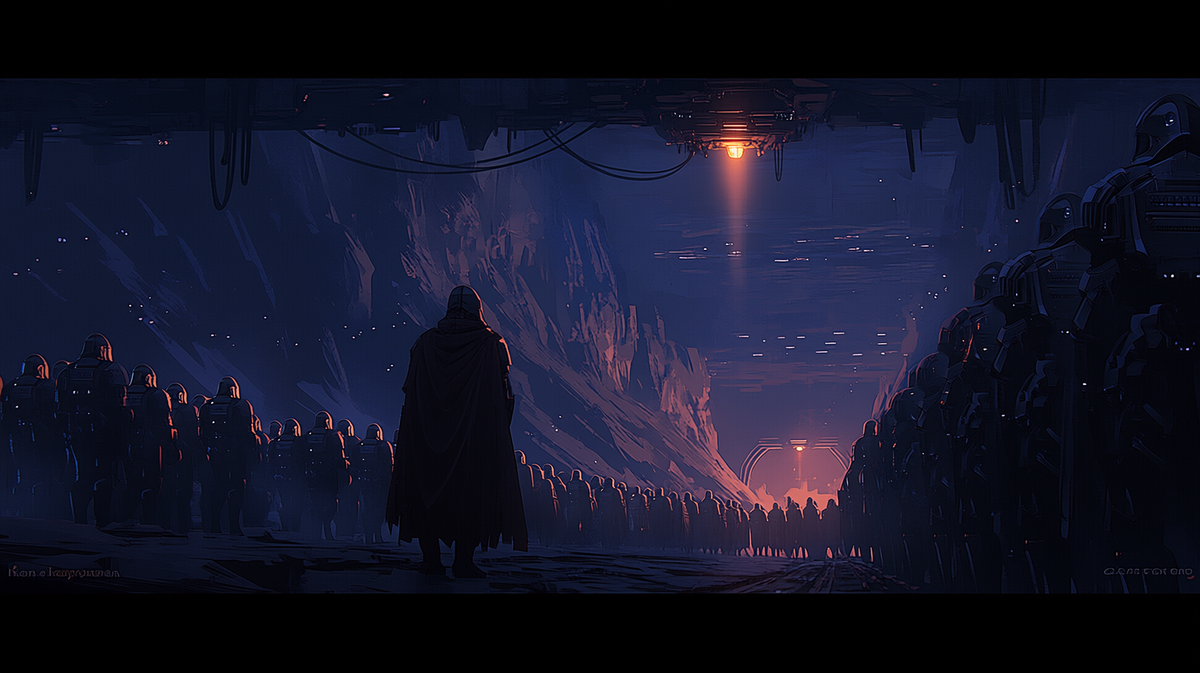
"Commander Cody, the time has come. Execute Order 66." — Darth Sidious, Revenge of the Sith
The clone troopers don't hesitate. That's the thing. They're mid-battle, fighting alongside the Jedi — loyal, capable, battle-forged — and the second the order comes through, they turn. Instantly. No deliberation. No conflict. Because the kill switch was always there. It was just dormant.
That's not a horror story about betrayal. It's a horror story about design. The army was built with the kill switch pre-installed. The Jedi generals just didn't know.
I've been thinking about that scene for two years. Every time another VP of Engineering publishes something on LinkedIn about "AI-native orgs." Every time a planning cycle comes back with flat headcount and doubled scope. Every time someone who used to talk about investing in our engineers starts talking about throughput.
The kill switch was always there. We just hadn't received the order yet.
The Two Armies ⚔️
Let me establish the battlefield before we go further.
Clone troopers = Human engineers
Battle droids = AI coding agents, LLM-powered tools, autonomous code generation
The Republic = Traditional software engineering organizations
The Separatists = The "AI-first, headcount-last" faction — VCs, cost-optimizers, AI-native startups
The Jedi = Engineering leaders who fought for craft, developer experience, and autonomy
Darth Sidious / Palpatine = The executive agenda hiding behind "transformation"
The Clone Wars = 2022–2024, the AI tooling arms race
Order 66 = The moment "AI augments engineers" became "AI replaces engineers"
Anakin Skywalker = The engineering leader we thought was the chosen one
The suit = Full integration with the AI-productivity-above-all framework
Two armies. One battlefield. One hidden player controlling both sides.
🌊 Kamino: The Army Was Always Being Built Without Us
Here's the thing about the clone army: the Republic didn't commission it. Jedi Master Sifo-Dyas did — secretly, acting on a premonition the Council never approved. And by the time the Jedi discovered Kamino, the army was already trained, equipped, and waiting.
The parallel should be uncomfortable.
The large language models weren't built with engineering teams as the end user. They were built by research labs — OpenAI, Google Brain, Anthropic, DeepMind — with their own investors, their own incentives, and their own vision of what software development should look like. Engineers weren't in the design session. We weren't in the roadmap review. We found out about GitHub Copilot the same way everyone else did: a press release and a waitlist.
By the time most engineering orgs understood what these tools actually were — not fancy autocomplete, but proto-agents capable of scaffolding entire services — the army was already trained, equipped, and waiting.
We didn't commission this. We showed up and found it already deployed.
⚔️ The Clone Wars, 2022–2024: When We Still Thought We Were Winning
November 2022. ChatGPT launches and the engineering internet collectively loses its mind for about 72 hours, then splits.
Half the room: This is incredible, we're going to move so much faster.
Other half: This hallucinates constantly, you can't trust it in production.
Both halves: quietly, privately, terrified about what this actually meant.
That period — late 2022 through 2024 — was the Clone Wars. Two armies, neither definitively dominant. Battle droids scale faster and cost almost nothing to deploy. Clone troopers have something droids don't: judgment, context, the ability to adapt when the plan falls apart and the original requirements were wrong anyway.
The droid army won every engagement where the problem was well-specified.
The clones won every engagement where it wasn't.
And that map describes most of what software engineering actually is. Ambiguous problems. Moving requirements. Systems with history. Stakeholders who don't know what they want until they see the wrong thing. For a while, that felt like a defensible position.
Then Copilot shipped, engineers adopted it, and productivity went up in measurable ways — code completion, test generation, boilerplate elimination. Managers saw the numbers. The inference was immediate and wrong: if Copilot adds 30% velocity, what does a full AI engineer get us?
The math got done. Nobody asked whether the math was right.
🟢 The Jedi We Trusted
Every engineering org had them.
The leaders who got it. Who pushed back on feature factories. Who went to the mat for platform investment in Q4 planning when everyone else was cutting. Who could explain technical debt to a CFO without condescending to them or lying to them. Who said "developer experience is a business outcome" and actually believed it enough to fight for it when no one was watching.
I worked for one. Sat across a table from one at 11pm during an incident that was entirely avoidable if we'd gotten that infra refactor approved six months earlier. Watched one take real organizational fire for killing a project that would have shipped broken, because shipping it broken would have hurt the engineers who had to maintain it.
These were the Jedi. Not perfect. Not infallible. But genuinely trying to protect the craft and the people doing it.
For a while, it felt like they were winning. Platform teams got funded. DX work got roadmapped. "Shifting left on quality" stopped being just a slogan in some orgs. The force was present, if not strong.
Then the droids got good enough to write unit tests. And suddenly the Jedi's budget justifications got a lot harder.
😈 The Sith Were in the Building the Whole Time
Here's the thing about Palpatine: he didn't become a Sith during the Clone Wars. He was always one. He was Chancellor the whole time, steering the Republic toward its own destruction while everyone assumed he was the steady hand.
The engineering equivalent isn't a cartoonish villain. It's subtler.
It's the executive who asked for "better developer velocity metrics" four years before AI was viable — not to improve the lives of engineers, but to build the baseline for headcount reduction once a productivity multiplier arrived. It's the org that funded the internal AI platform team not out of genuine investment in developer experience, but to build the infrastructure for replacement. It's the board presentation where "AI-augmented engineering" is a cost story from the first slide and everyone knows it except the engineering team, who got told it was about empowerment.
You can't always spot a Sith. That's the point. They hold the title. They sit in the right meetings. They say the right things about psychological safety and technical excellence at All Hands. And they're simultaneously doing spreadsheet math that ends with a smaller engineering org, waiting for the model quality to cross the threshold that makes the math politically viable.
The agenda was always about throughput per dollar. AI finally made the math work.
🌑 Anakin's Fall: The Chosen One Integrates with the Machine
This is the part that actually stings.
The Sith lords are easy to be angry at — they were always opposed to us. But Anakin was us. Rose through the ranks as an IC, to manager, to director. Could write the code, debug the distributed system at 2am, argue the architectural tradeoff without a slide deck. When he made it to the room where decisions get made, you trusted that someone in that room remembered what it actually felt like to X-Wing code.
Then he watched what AI could do. Really watched.
Maybe it was the fully autonomous agentic development demo. Maybe it was a Claude session where an agent scaffolded a working service in eleven minutes flat. Maybe it was the consultant's spreadsheet — cost-per-feature with and without AI augmentation, projected out eighteen months. Whatever the catalyst, something shifted.
The chosen one started talking differently. Stopped pushing back on scope assumptions. Stopped asking but what does this do to the team? Started asking how do we get the team to adopt this faster? Started measuring engineers on AI utilization rates. Started describing engineers who were skeptical as "resistant to change" rather than "experienced enough to know what doesn't work yet."
The suit goes on piece by piece. It's never one moment. It's a hundred small compromises, each individually defensible, collectively catastrophic. And then one day you look up and the person who was supposed to fight for engineering culture is the one mandating AI tool adoption, setting agent-assisted output benchmarks, and restructuring the org around workflows where engineers are less architects and more reviewers of machine-generated code.
He's not evil. That's the tragedy of it. He genuinely believes this is the right move.
He's also breathing through a respirator and it's mostly machine now.
⚡ Execute Order 66: The Mandate Already Came
You want a clean moment. A pivot you can point to.
It doesn't work that way. Order 66 wasn't announced. It was executed — simultaneously, across every theater of the Clone Wars, in a single encrypted transmission. One second the Jedi were generals. The next they were targets.
The engineering equivalent arrived the same way. Not as a single policy memo but as a pattern of simultaneous signals across orgs and industries, landing within the same 18-month window:
- Hiring freezes framed as "right-sizing for an AI-augmented future"
- Reorgs that quietly eliminated principal and staff engineering roles
- Platform teams and products defunded — LLMs handled enough of what they built to justify it
- Performance criteria with new dimensions: AI tool adoption, agent-assisted commit volume
- Planning cycles that assumed AI productivity multipliers before anyone had validated them in production
- Job postings that used to say "5+ years experience" now saying "AI-native mindset required"
It happened fast. Pandemic-fast. The way remote work shifted in March 2020 — where the thing that seemed like a slow-moving trend became a mandate over a single weekend. One moment you were in a genuine debate about whether AI was ready for production workloads. The next, the debate was over and you were being handed an adoption timeline with a Q2 deadline.
The clones turned. The order was in them the whole time.
The Surviving Jedi
Not every Jedi died on Order 66. Some survived — went underground, stopped broadcasting their location, adapted.
Obi-Wan kept teaching. Yoda went into hiding but stayed clear-eyed about what had actually happened and what it meant. The ones who survived weren't the ones who tried to fight the clone army head-on after the order came. They were the ones who understood what had fundamentally changed, accepted the loss without flinching from it, and figured out how to remain useful in the new order without becoming the new order.
I'm not going to tell you AI is just a tool and nothing fundamental has changed. That's the take of someone who didn't watch Order 66 land.
Something fundamental has changed. The "augmentation vs. replacement" debate is largely over, and not in our favor — not at the level of headcount planning, not at the level of how engineering orgs get sized in the next budget cycle. That's real.
But the thing that made the Jedi Jedi — judgment, context, knowing which fight is the right fight — that doesn't get deprecated by a model update. It gets more valuable in a world full of agents that execute brilliantly and reason poorly. Someone has to know what to build. Someone has to know when to stop. Someone has to be in the room when the requirements are wrong and the droid army is about to scaffold the wrong service at 10x velocity.
The force isn't gone. It's just underground like a buried lightsaber.
Stay there until you understand the landscape.
Then come back.
Teach.


