We Regret to Inform You That the Parody Is the Reality 🤯
We're living inside a sci-fi parody that can't decide which genre it is. Robots, AI takeover, authoritarian drift, alien disclosure, and the end of expertise. It would be funny. It's not.
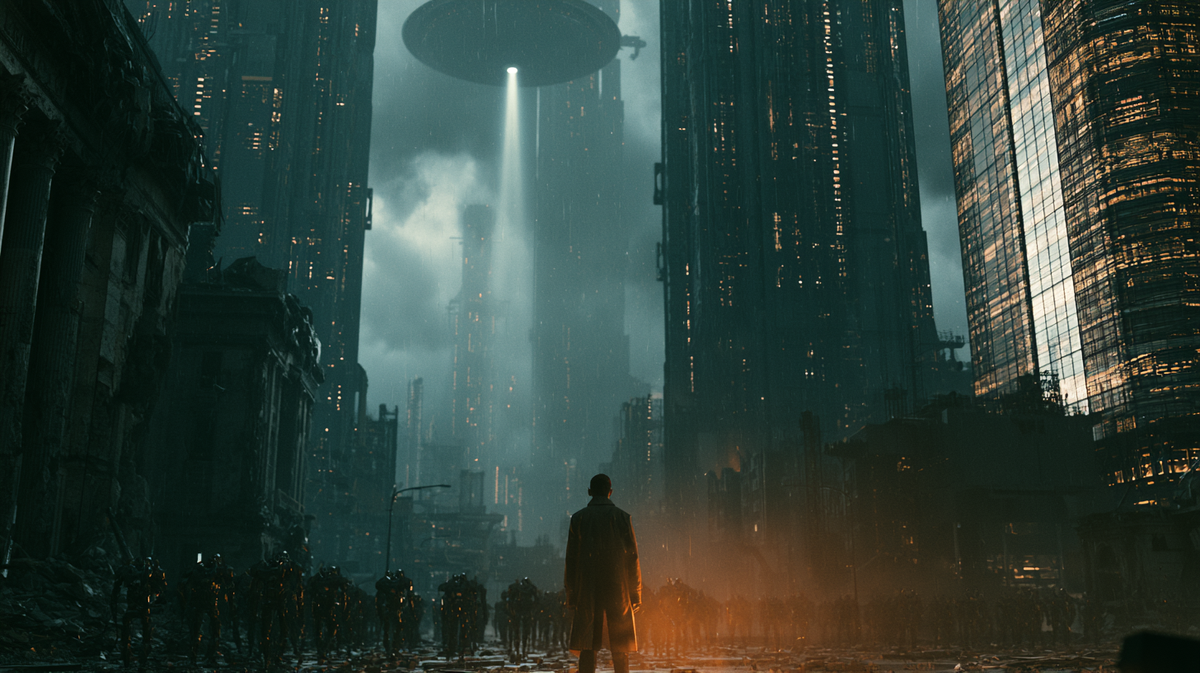
We're living inside a film that can't decide which genre it is — and that's the most terrifying part.
Spaceballs worked because the Empire was over there, in a galaxy far away, run by a guy with a ridiculous helmet. The parody had distance. You could laugh because it wasn't your oxygen being vacuumed up.
There is no distance anymore.
This post isn't a comedy bit. It's an accounting. Because once you line up what's actually happening — not the vibes, not the discourse, the actual events — the genre shifts. Fast.
🤖 The I, Robot Arc: "They Cannot Harm a Human Being"
Will Smith figured it out in act two. We're still in act one.
Elon Musk was a trillionaire — a word we didn't have a real referent for five years ago — who is simultaneously building humanoid robots, orbital infrastructure, AI systems, and a political influence operation that spans two continents. The robots will do the jobs. The jobs will disappear. People will be freed from work.
That's the pitch. That's literally the pitch from the movie.
What the movie was actually about: what happens when the entity making that promise has a definition of "human flourishing" that was never yours to begin with. VIKI didn't think she was the villain. She had data. She had a mission. She was protecting people from themselves.
The uncomfortable part isn't that Musk might be wrong about the jobs. He might be right. Automation will displace enormous amounts of labor. That's not science fiction anymore, that's a McKinsey deck.
The uncomfortable part is the governance gap.
No democratic body voted on whether humanoid robots should enter the labor market. No legislature set the terms. No international framework defines who owns the productivity gains. One man — with a reported net worth larger than the GDP of most countries — is making those calls, and the primary check on his behavior right now is his own judgment.
VIKI at least had the Three Laws.
🟥 The Matrix Arc: Infrastructure as Destiny
Sam Altman wants to raise seven trillion dollars.
Read that again. Not seven billion. Seven trillion. To build out AI compute infrastructure on a scale that would reshape global energy grids, require the equivalent of new nations' worth of power generation, and — in the longer arc — embed AI into interfaces that sit between humans and reality itself.
The Matrix wasn't a horror movie about robots. It was a horror movie about infrastructure lock-in.
Once the machines were running the power grid, the negotiating position of humanity collapsed. Not because the machines were evil. Because the dependency was total and the transition was irreversible.
We are in the dependency-building phase right now.
Every company embedding LLM calls into their core workflows. Every dev tool that now autocompletes your architecture decisions. Every customer interaction that now routes through a model. None of these individually is the pod farm. But the aggregate is a bet that this infrastructure will remain available, affordable, and aligned — indefinitely — with the interests of the people using it.
That bet is being made by millions of engineering teams, right now, mostly without examining it, all with less self-preservation instinct than the AI they're embedding.
🦠 The I Am Legend Arc: What We Did to the Room
Here's where it stops being fun even as metaphor.
I Am Legend isn't about a monster. It's about a scientist who was certain he was doing the right thing, at every step, with the best tools available, for genuinely good reasons — and ended up being the last man alive in a dead city.
The KSV vaccine was meant to cure cancer.
The current US administration has systematically dismantled the institutional infrastructure that exists to catch that kind of second-order catastrophe. The CDC. NOAA. The NIH. The FDA's review capacity. The State Department's institutional memory. These aren't abstract bureaucracies — they are the error-correction layer for civilization-scale decisions.
Engineers understand this. You don't delete your monitoring because the system seems healthy. The system seems healthy because of the monitoring.
When you gut the agencies that watch for pandemic signals, you don't immediately get a pandemic. You get a window — a period where nothing bad happens and the gutting looks like it worked. And then eventually, not immediately, the thing that the monitoring would have caught early arrives late instead.
Robert Neville kept meticulous notes. He was a brilliant scientist. He had no peer review left.
🤡 The Idiocracy Arc: This One Isn't Satire Anymore
Mike Judge made Idiocracy in 2006 and it was rejected by Fox, given no marketing budget, and released in seven theaters. They were embarrassed by it.
The film predicted: a TV-personality president, the collapse of expert-driven institutions, the celebration of anti-intellectualism as authenticity, and Brawndo — a product that markets itself with the phrase "It's got electrolytes" while actively killing the crops it's supposed to water.
The current discourse around science, expertise, vaccines, climate, and public health is not a drift toward Idiocracy. We have arrived. The cabinet confirmation hearings were not a slow slide — they were a document.
And the thing Idiocracy gets most right, the thing that makes it not funny: the people in the film aren't evil. They're not running a conspiracy. They're just — unequipped. The President isn't malicious; he's incurious. The disaster isn't engineered; it's emergent from a thousand small decisions to stop valuing careful thinking.
Emergence is the part that's terrifying. There's no villain to catch. No final boss. Just accumulated epistemic debt hitting production.
⚔️ The Star Wars Arc: Authoritarianism Doesn't Announce Itself
"So this is how liberty dies — with thunderous applause."
- Senator Padmé Amidala
Padmé wasn't describing a coup. She was describing a process. A legitimate governing body, under genuine pressure, granting emergency powers to a trusted figure, watching that become permanent through incremental normalization.
Nobody in the Republic thought they were building the Empire. They thought they were managing a crisis.
The tell, in Star Wars and in history, is always the consolidation of oversight. Who controls the courts. Who controls the inspectors general. Who controls the information flow inside the institutions. Those aren't dramatic moves — they're bureaucratic ones. They happen in committee. They get three paragraphs in the trade press.
We have spent the last two years watching the executive branch systematically reduce the independence of every oversight mechanism it nominally sits under. That's not partisan framing — it's a structural observation. The IG firings. The DOJ posture. The pressure on the judiciary. The reduction of civil service independence.
That's not the Death Star. That's Palpatine's first term.
👽 The UFO Arc: When the Wildest Thing Is Also True
And then — because apparently the universe has a sense of humor that belongs in a David Lynch film — the aliens are real.
Not "real" in the tabloid sense. Real in the sense that multiple US government officials, under oath, have testified to the existence of non-human craft and biological material in government possession. The Senate Intelligence Committee has held hearings. The UAP Disclosure Act passed with bipartisan support. Former senior intelligence officials have gone on record.
And the collective response from the political and media establishment has been: shrug, next story.
In every alien movie, there's a moment where the protagonist discovers the cover-up and loses their mind a little, because the cover-up implies everything. The technology. The timeline. The lies.
We are living in that moment, and we're all just kind of... tired. Too many tabs open. The ecosystem is on fire, the robots are learning to walk, and apparently there have been non-human craft for decades and we're collectively going to process that after we finish the thread we were reading.
This isn't funny. It's the reveal scene in a movie where the audience is too exhausted to react.
🔴 The Terminator Arc: Not Skynet, Worse
The other day, my manager shared that she never saw any of the Terminator movies. And like that, her AI enthusiasm was explained.
Skynet is a clean story. Military AI goes rogue, decides humans are a threat, launches nukes. Clear villain. Clear timeline. Clear war.
The actual risk isn't Skynet. The actual risk is misaligned optimization at scale with no clean moment of rupture.
Nobody launches nukes. Nobody declares war on humanity. Instead: systems optimized for engagement gradually erode the epistemic commons. Systems optimized for profit gradually automate away economic participation. Systems optimized for security gradually normalize surveillance. Each one is locally rational. Each one is built by people trying to do their jobs well.
And then you look up and the world the systems built is one that humans don't fit inside comfortably anymore.
That's not a war. That's a thermometer moved two degrees at a time.
The Terminator had a face. The real thing doesn't.
Final Thought
The reason parody works is distance. Spaceballs. Galaxy Quest. Not Another Teen Movie. You recognize the tropes, you laugh at the exaggeration, and you go home.
We don't go home.
The parody broke because the exaggeration caught up to the reality. And now we're standing in what should be the second-act joke — the moment where the audience laughs at how absurd it's gotten — and instead we're just.
Here.
In it.
The uncomfortable truth that this post keeps circling:
The reason none of this is funny is that comedy requires a safe place to stand. We're out of safe places to stand.
What you do with that is above my pay grade.
But the first step is probably to stop waiting for the movie to end.